Product Overview
📌 Overview — Juniper MX240
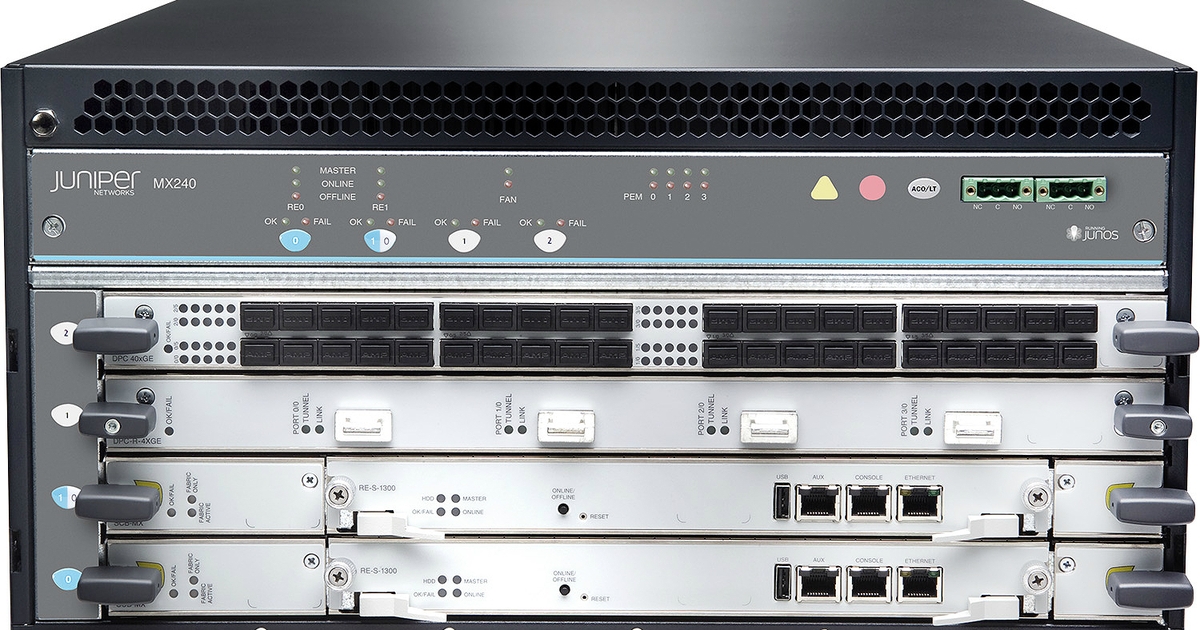
The Juniper MX240 is a modular, high-performance Universal Routing Platform designed for service providers, large enterprises, data centers, and cloud networks. It delivers scalable routing, advanced services, and automation capabilities in a relatively compact form factor. It is part of Juniper’s MX Series 3D Universal Edge Routers and runs the Junos® Operating System, which provides consistent network management and programmability across Juniper platforms.
🧠 Key Specifications
🛠 Architecture & Performance
- System capacity: up to ~3 Tbps switching/routing capacity, suitable for high-bandwidth environments.
- Chassis: 5U rack-mount modular platform with multiple slots for service cards and control cards.
- Programmable silicon: Powered by Juniper’s Trio chipset for wire-rate forwarding and advanced services scaling.
🌀 Interface & Expansion
- Supports high-density 10 GbE, 40 GbE, and 100 GbE interfaces (port counts vary by line card).
- Modular Service Card (MPC) and Switch Control Board (SCB/SCBE) architecture enables mix-and-match interfaces and upgrade flexibility.
💻 Software & Routing
- Runs Juniper Junos OS, a modular, reliable network OS with a unified CLI and rich protocol support (OSPF, BGP, MPLS, EVPN, etc.).
- Supports advanced features like MPLS, QoS, multicast, and Layer 2/Layer 3 services depending on configuration.
📡 Security & Services
- Inline services and security features including MACsec encryption on supported cards at line rates.
- Integrated service support for automation, flow telemetry, and subscriber services.
📦 Physical & Power
- Form factor: 5U rack chassis with redundant fan trays and power supply options.
- Typical weight (fully loaded): up to ~58 kg; requires standard 19″ rack space.
- Power redundancy and field-replaceable units enhance uptime.
⭐ Core Features
🔹 Modular & Scalable
The MX240’s modular design with MPCs and control cards allows network operators to scale port density and services as needed, making it suitable for evolving network demands.
🔹 High Performance
With multi-terabit capacity and line-rate forwarding, the MX240 meets the performance requirements of dense edge deployments and metro/core routing.
🔹 Rich Protocol Support
Supports extensive routing protocols (BGP, OSPF, IS-IS), MPLS, VPN services, and service chaining for complex network topologies.
🔹 Programmability & Automation
Junos OS includes automation frameworks such as Junos Automation, NETCONF/REST APIs, and integration with network automation tools — simplifying configuration and operational workflows.
🔹 Security & Encryption
Support for MACsec and other secure transport features on high-speed interfaces delivers robust link security without sacrificing performance.
🛠 Compatibility
🖥 Operating System
- Runs Juniper Junos OS, which is widely used across Juniper routing platforms and supports upgrades, scripting, and automation tools.
🔌 Interoperability
- Works seamlessly with other Juniper MX Series (e.g., MX480, MX960) due to shared architecture and control plane.
- Integrates into multiservice provider networks supporting common protocols and VPN services (MPLS L3VPN, EVPN, etc.).
📡 Network Compatibility
- Fully compatible with existing Ethernet, MPLS, IP routing, and SDN/NFV ecosystems in service provider and enterprise WAN/Core networks.
⚙️ Management & Automation
- Managed via CLI, Junos Space, or automated interfaces (NETCONF/YANG/REST) for streamlined deployments and telemetry integration.
📈 5G & Cloud-Era Readiness
- Designed for emerging trends like 5G, cloud networking, and IoT traffic growth, offering flexible support for both legacy and modern network services.
📊 Typical Deployment Use Cases
- Service Provider Edge/Core Routing: Broadband delivery, MPLS backbone, interconnect services.
- Enterprise WAN Aggregation: High-capacity edge router for campus or corporate backbone links.
- Data Center Interconnect: High-throughput routing between data centers and cloud edges.
- 5G Mobility & IoT Edge: Supports multi-service environments and dense, high-speed connectivity needs.